
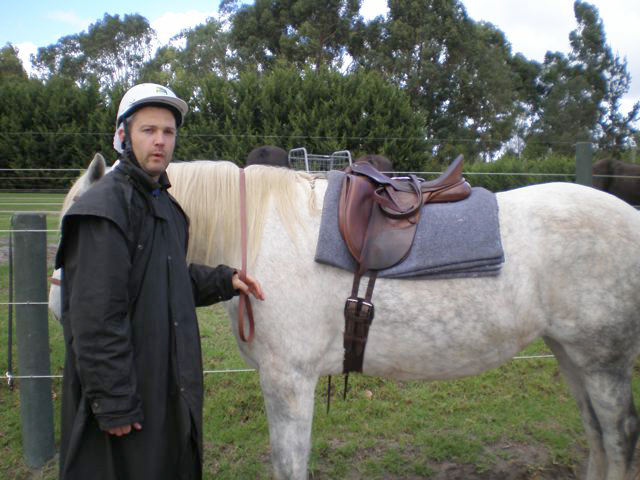
English tourist to Western Australia “He was pretty interested in the mohair girth and thought it was fantastic that we took such care of our horses by using those girths as opposed to synthetic ones.” Photo by Tahita Lang
One of the most encouraging e-mails we have received to date. The sender writes from Western Australia:
“We received this e-mail just a second ago and I couldn’t copy and send it fast enough to you!
All through winter (mild though it is compared to yours) we have been kept busy with our tourist-based trail riding business – all the horses in the trail string have their own fitted saddle and mohair girth! We get many comments on how beautiful our horses look and how nicely they move (the connection between that and our student’s email below is not to be sneezed at!).
Anyway, I am just so happy to have been able to send you some feedback from people other than us. This email was completely unsolicited…
“…By the way, I am having much success with the mohair girth that Sasha fitted and Tahita ordered for me a few months back. The difference in my horse is quite astounding, he does move more freely, forward is much less of an issue, and saddling has changed into a more pleasant process. He no longer looks miserable and blank eyed, grabbing his girth and grinding his teeth on it, throwing it around, or tensing himself up when being girthed, taking baby steps away from me. He is relaxed and engaged, girth tightens up in less stages, and he stands solid. He was trying for years to tell me his girth was a problem, I was too thick to see it. I hope you see a difference in him in October. – Regards, Jodie.”
All the best to you both, Tahita”
(Update Nov 2016) The above story is very similar to hundreds we have heard from customers and students around the globe as a testimony that improvements to Equine health and comfort are realistic and achievable when sufficient analysis and skill are applied. For many years I had maintained the ArtCords, LLC Official online store providing project ideas, downloads, supplies, and finished products as the primary form of income to further the cinch education. My greatest desire has always been to see an increase in and availability of quality materials and supplies, especially accurately labeled cordage and detailing yarns for independent crafts-folk. Personal experience with natural animal fibers has convinced me that period and contemporary cinch designs, ropes, and other cordage creations will last for two decades and more when reasonable consideration is given to each step from raw fiber to finished article.
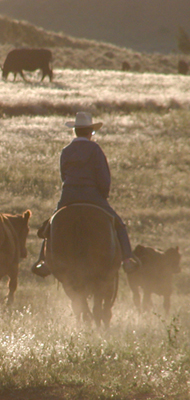
Darin’s late Cousin, Jeanie Greet-Jeffers moving cattle on the Wyoming ranch where she grew up.
The many makers and consumers who have witnessed censorship in social media combined with soaring expense and diminishing quality of commercially available supplies, recognize how stories of creativity and options for long-term financial savings have been suppressed in particular situations. Strangely the censorship seems to occur primarily against those with heart-felt dedication of offering more sustainable price-points while sharing thoughtful revelations from personal experiences. Those who search far enough are likely to find few if any situations where natural fiber cordage and cinch materials/supplies are being held to international standards of wholesale/retail price calculations. The growing number of individuals approaching me with practical questions in recent years on design and materials issues, including veterinarians, have expressed a firm belief that cinch research would prove a valuable benefit to the Equine industry, has encouraged consideration of the likelihood that alternative funding support for key Agrarian Skills Research & Public Education endeavors is out there.
Your generosity is appreciated as we continue to receive requests that I share these unique experiences and perspectives with wider audiences. Current and future opportunities include invitations from Equine researchers who wish to add the cinch study to ongoing saddle research as well as my work to bring obscure methods of organic soil healing into established plant trials for a multi-year study. Admittedly, more people seem interested in eating well rather than riding horses, and I have been discovering that many of those interested in the fiber and Equine industries may also appreciate learning about successful methods for growing food and ornamental plants. To this end, I offer a number of presentation and demonstration formats to meet your group or organization focus.
Thank you, I look forward to hearing from you!
Kindest regards ~ Darin Alexander
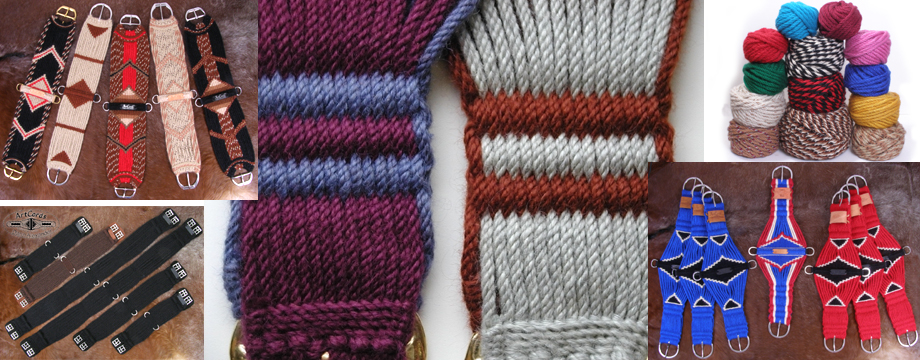
Examples of custom, made-to-order cinches with top Right corner showing hand-plied cords made in the ArtCords’ studio

2 comments
Love your blog, in fact arrived by checking yahoo and google for a comparable issue to this post. Which means this might be a late post nevertheless keep up the great work.
I really like your writing style, great information, thanks for posting : D.